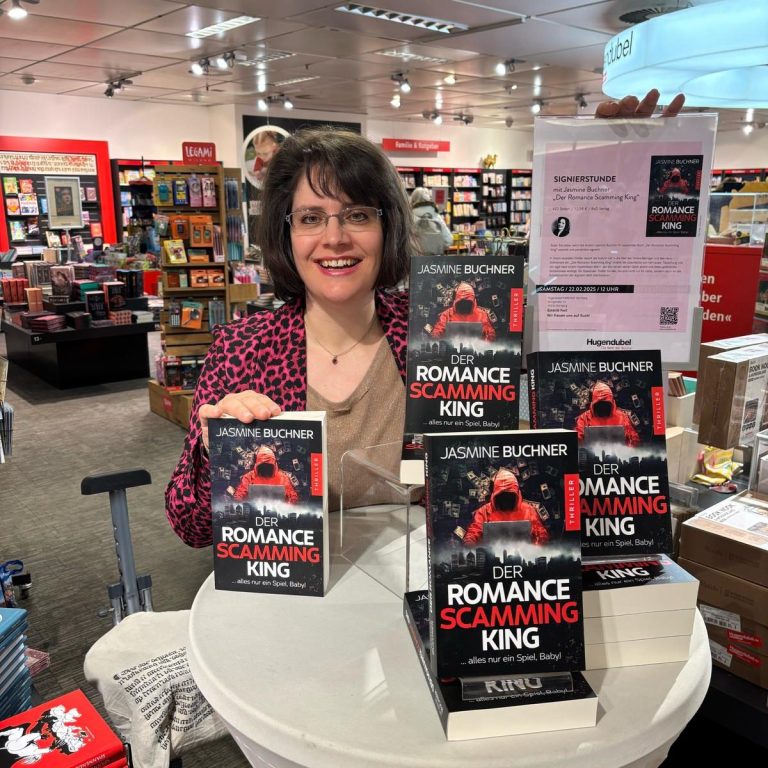

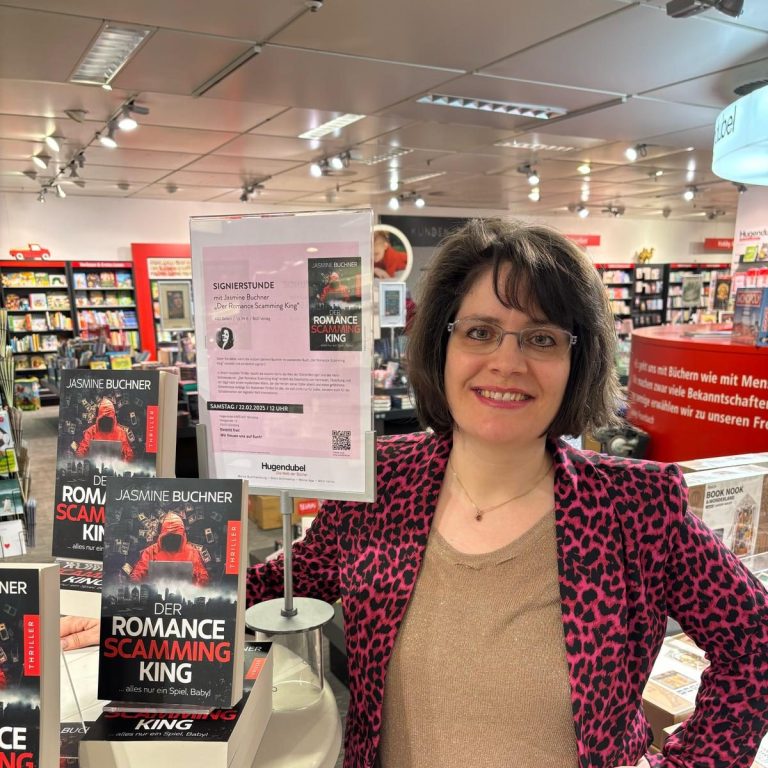

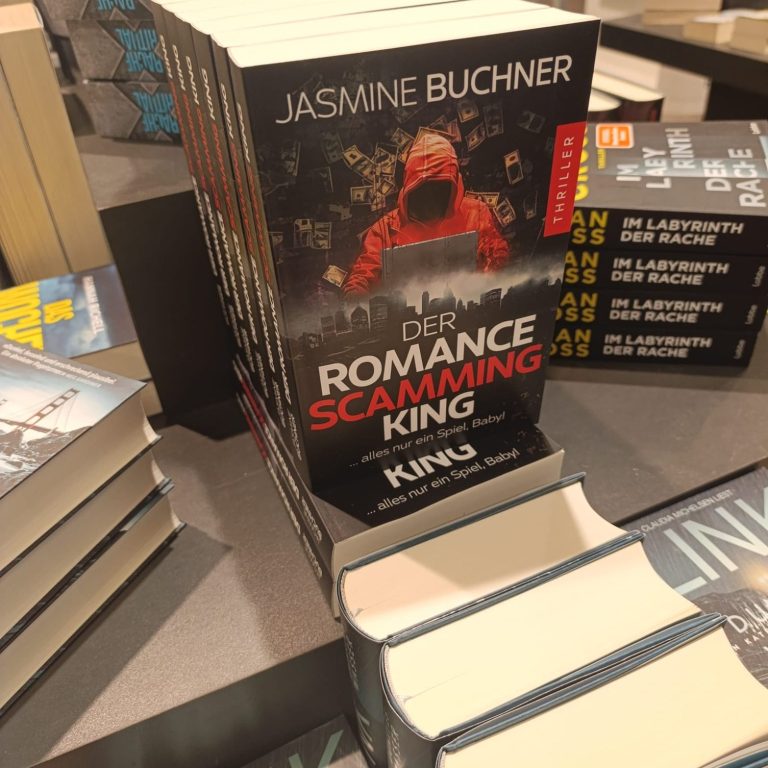

Signierstunde im Hugendubel Nürnberg 22. Februar 2025/Signing session at Hugendubel Nuremberg, February 22nd,2025
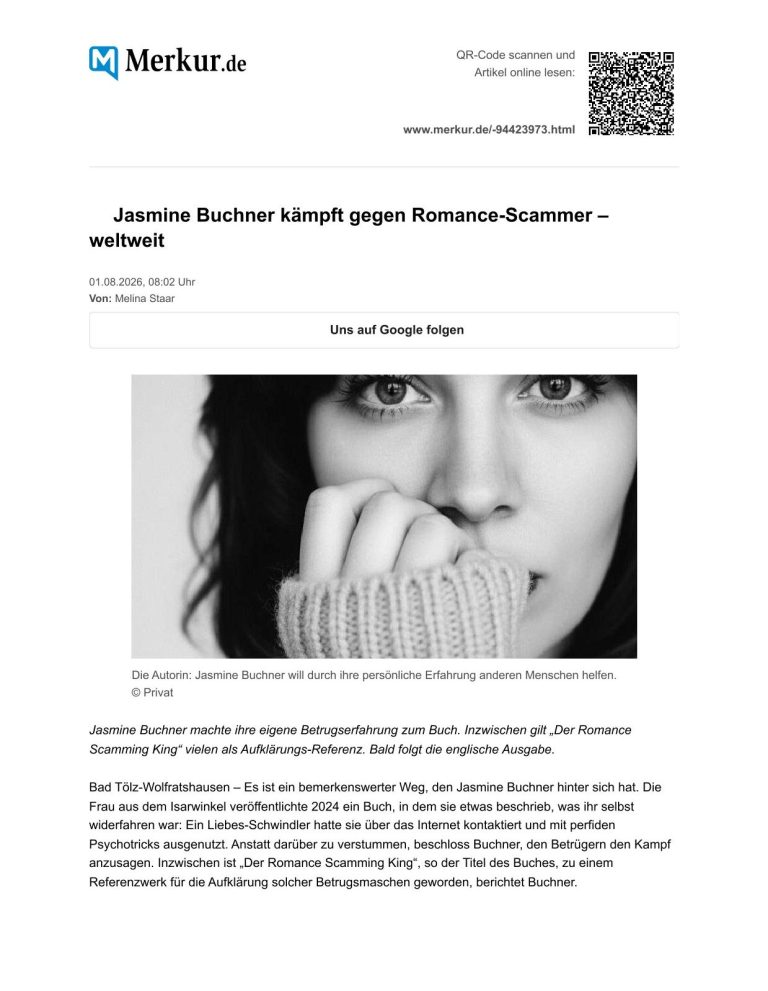
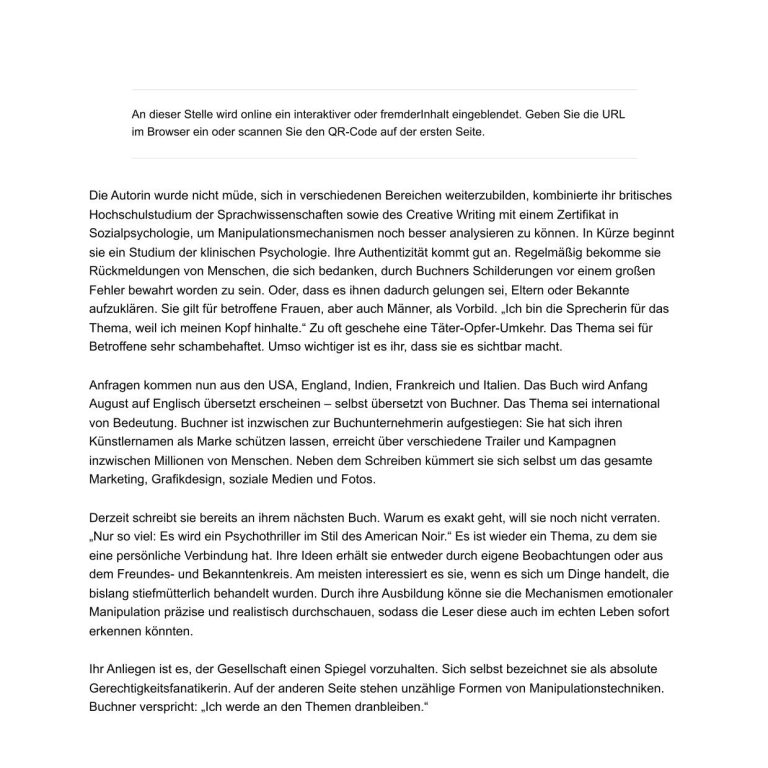
Artikel merkur.de vom 01.08.2026/Article in German on merkur.de from 08/01/2026
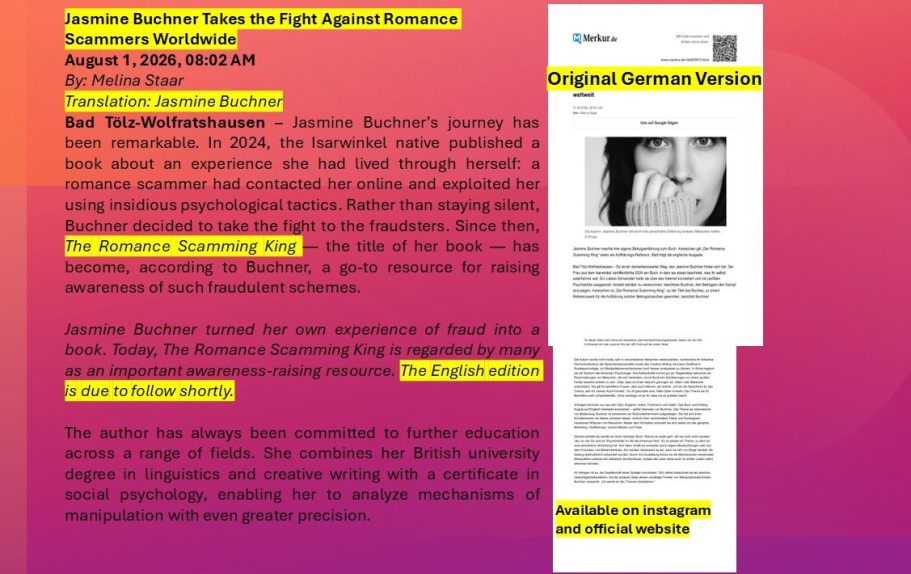
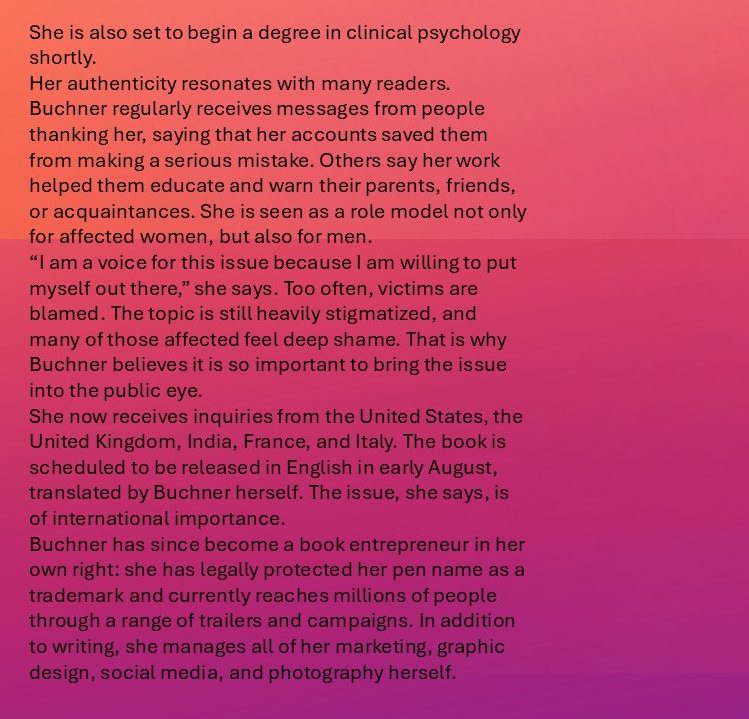
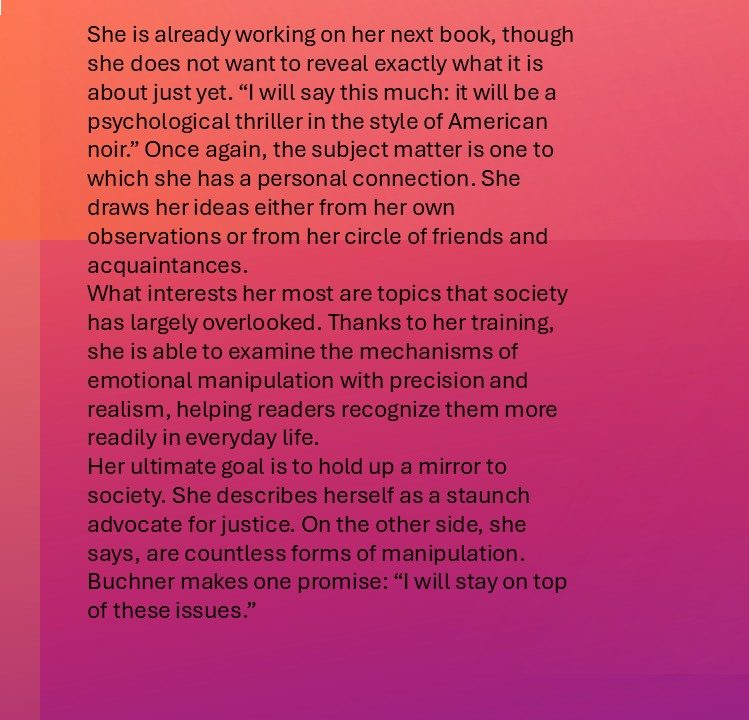
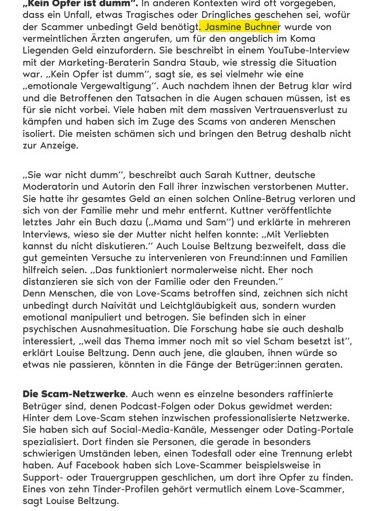
Artikel aus dem feministischen Wiener Magazin An.Schläge, in dem Jasmine Buchner zitiert wird
Featured article in the feminist Viennese magazine an.schläge, quoting Jasmine Buchner.
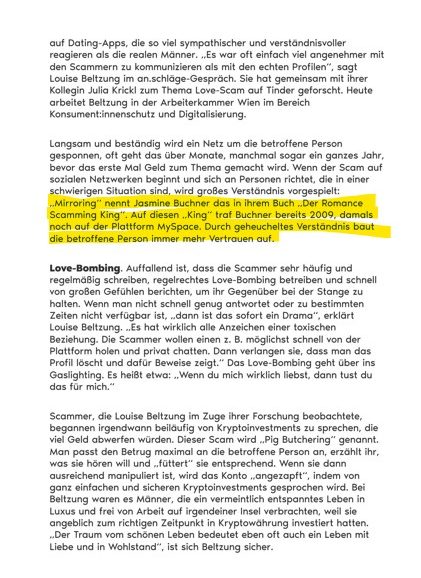
Double Deception
"Love Scamming" has increased massively in recent years; billions are now plundered through this so-called marriage fraud. Yet, with this fraudulent scheme, there are victims on all sides. By Nina Süssmilch
A Viennese man is alleged to have swindled 150,000 euros from several women he met on dating platforms—in autumn, he was sentenced to a prison term for it. "The Viennese Tinder Swindler?", asked the magazine Falter. So-called love scammers have consistently provided material for sensationalized media formats; victims often experience mockery and ridicule. The scam thrives online, even though it is by no means an invention of the internet: marriage fraud also existed in the analog era.
Many people associate this with old, desperate "spinsters," or naive and gullible women who failed to get "under the hook" in time and were treated particularly badly by a patriarch and his promises of protection. However, current data demonstrates that today, both men and women are affected by love scamming—the fraud primarily strikes individuals between forty and sixty years old. Yet we are all vulnerable to this type of scam, as it targets a universal human need: the desire for recognition and love.
What is a Love Scam? It often begins like this: A supposedly wrong number suddenly appears on Telegram, and the profile behind it engages the target in a seemingly casual conversation. Male profiles on dating apps, which react so much more sympathetically and understandingly than real men. "It was often simply much more pleasant to communicate with the scammers than with the authentic profiles," says Louise Beltzung in an interview with an.schläge. Together with her colleague Julia Krickl, she conducted research on the topic of love scams on Tinder. Today, Beltzung works at the Chamber of Labour Vienna (Arbeiterkammer Wien) in the field of consumer protection and digitalization.
Slowly and steadily, a net is woven around the targeted individual, a process that frequently spans months, sometimes even an entire year, before financial matters are raised for the first time. When the scam begins on social networks and targets individuals who find themselves in a difficult situation, profound empathy is simulated.
"Mirroring" is what Jasmine Buchner calls this in her book "The Romance Scamming King." Buchner encountered this "king" back in 2009, on the platform MySpace at the time. Through hypocritical empathy, the affected individual develops an ever-increasing level of trust.
Love-Bombing. It is striking that the scammers write very frequently and regularly, engaging in outright love-bombing and quickly reporting intense emotions in order to keep their counterpart engaged. "If you don't reply quickly enough or if you are unavailable at certain times, drama ensues immediately," explains Louise Beltzung. "It truly exhibits all the signs of a toxic relationship." The scammers want to pull the target off the platform as quickly as possible to chat privately. Then, they demand that the profile be deleted and ask for "proof" of it. This love-bombing escalates into gaslighting. It translates roughly to: "If you truly love me, you will do this for me."
Scammers observed by Louise Beltzung during her research eventually began to speak casually about crypto investments that would yield substantial profits. This scam is known as "Pig Butchering." The fraud is customized to the absolute maximum to fit the targeted person, telling her exactly what she wants to hear and "feeding" her accordingly. Once she is sufficiently manipulated, the account is "tapped" by discussing very simple and secure crypto investments. In Beltzung's research, these were men who supposedly spent a relaxed life in luxury and free from labor on some island because they had allegedly invested in cryptocurrency at the exact right moment. "The dream of a beautiful life simply often implies a life with love and prosperity," Beltzung notes with certainty
"No victim is stupid." In other contexts, it is often feigned that an accident, a tragedy, or an urgent emergency has occurred, for which the scammer urgently requires financial funds. Jasmine Buchner was called by alleged doctors demanding money for a supposedly comatose lover. She describes in a YouTube interview with marketing consultant Sandra Staub how stressful the situation was. "No victim is stupid," she says, stating that it is rather akin to an "emotional rape." Even after the deception becomes clear to them and the victims must face the facts, it is far from over for them. Many struggle with a massive loss of trust and, in the course of the scam, have isolated themselves from other people. Most feel ashamed and therefore do not report the fraud to the police.
"She was not stupid," was also how Sarah Kuttner, German presenter and author, described the case of her now deceased mother. She had lost her entire fortune to such an online fraud and increasingly distanced herself from her family. Kuttner published a book about it last year ("Mama und Sam") and explained in several interviews why the mother could not be helped: "You cannot reason with someone who is in love." Louise Beltzung also doubts that well-intentioned attempts to intervene by friends and family are helpful. "That usually doesn't work. Instead, they distance themselves from their family or friends."
Because people affected by love scams are not necessarily characterized by naivety and gullibility, but were emotionally manipulated and defrauded. They find themselves in a psychological state of emergency. Beltzung explains that the research interested her precisely because "the topic is still fraught with so much shame." For even those who believe this could never happen to them could fall into the clutches of fraudsters.
The Scam Networks. Even if they appear to be exceptionally sophisticated individual fraudsters to whom podcast episodes or documentaries are dedicated: Behind the love scam now stand highly professionalized networks. They have specialized in social media channels, messengers, or dating portals. There, they target individuals who are currently living in particularly difficult circumstances, having experienced a death or a separation. On Facebook, for instance, love scammers have sneaked into support or grief groups to find their victims there. One in ten Tinder profiles probably belongs to a love scammer, says Louise Beltzung.